
What is a forklift?
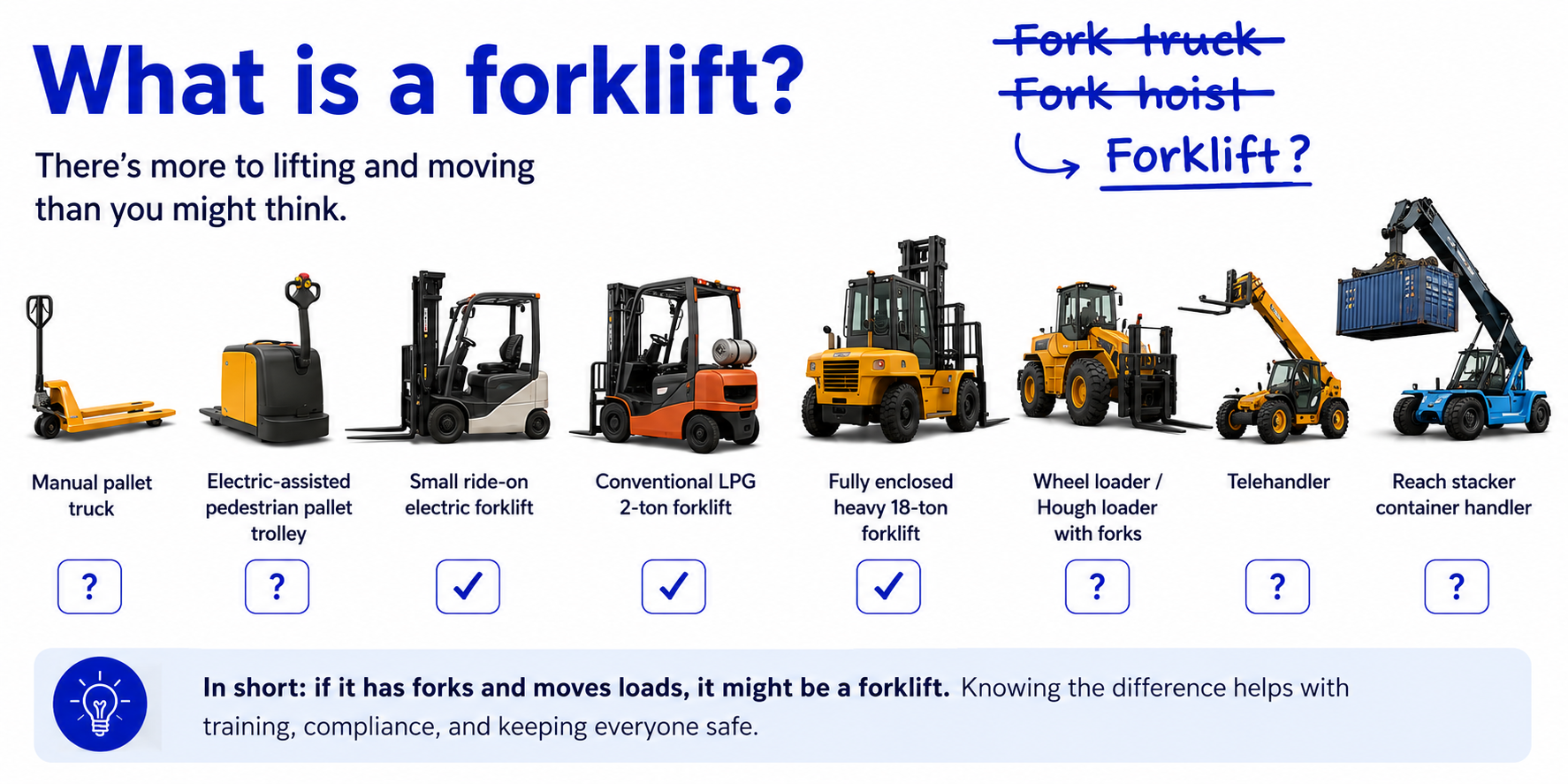
Most people think they know what a forklift is.
A standard warehouse forklift? Easy.
A manual pallet jack? Probably not.
An electric pedestrian pallet trolley...?
A telehandler??
This is where the confusion starts.
The simplest way to look at it is this: once you move from a manual pallet jack to powered lifting and moving equipment, you have entered forklift operator territory. Once the machine gets more specialised, such as a telehandler or container handler, it usually needs its own specific training or certificate. Not all forklifts look like your classic LPG machine, but all operators need the right training, competency and authorisation for the equipment they are using.
Manual pallet jack versus powered pallet trolley
A manual pallet jack does not require a forklift operator certificate, although staff still need to be shown how to use it safely. A powered pedestrian pallet trolley is different. Even though the operator walks behind it, the equipment is powered, moves heavy loads and can create serious crushing, impact and pedestrian risks. In practice, these machines should be treated as powered industrial lift trucks and operators should hold a current forklift operator certificate. Exceptions can be made when operators are trained and assessed through a robust internal competency system but, for the majority of businesses, the easiest way to facilitate this is through recognised forklift training. The key point is not whether the operator sits down or stands up. The key point is whether the machine is powered and capable of lifting, carrying or moving loads.
An F endorsement is not a lifelong green light
A forklift operator certificate and an F endorsement are not the same thing. A forklift operator certificate shows the person has been trained and assessed to operate a forklift in the workplace. It expires after three years. An F endorsement sits on a driver licence and is needed when a forklift is operated on a road or in a public place.
So, if someone says, “I’ve got my F endorsement,” the next question should be, “Is your forklift certificate current?”
The endorsement deals with road use. The certificate deals with workplace operation. You may need both.
How far does a forklift certificate and F endorsement get me?
For most standard workplace forklifts, a current forklift operator certificate is the starting point. If the forklift is only being used on private property, the operator should hold a current forklift operator certificate and be authorised by the business to use that equipment. If the forklift goes onto a road or public place, the operator will also need an F endorsement on their driver licence. For forklifts up to 18,000 kg gross laden weight, a Class 1 licence with an F endorsement is enough. If the forklift is over 18,000 kg gross laden weight, the operator needs a Class 2 licence with an F endorsement.
Can I drive a centre-steer Hough with forks? Do I need a W endorsement?
This is where the word “forklift” can cause confusion. A forklift is not simply “anything with forks attached”. A wheel loader, Hough loader or similar centre-steer machine does not automatically become a forklift just because it has forks. If it is a purpose-built forklift, the road-use endorsement is F. If it is a wheeled special-type vehicle that is not a forklift, the road-use endorsement is generally W.
So, if you have a centre-steer Hough or loader with forks fitted, treat it as the machine it actually is: a loader fitted with a fork attachment. On a private site, the operator needs training and assessment for that machine, that attachment, that task and that terrain. If it is going on the road or into a public place, the operator needs the correct driver licence and endorsement for the actual vehicle classification. For a loader, that is likely to be a W endorsement, not an F endorsement.
Forklift: F endorsement for road use.
Loader with forks: likely W endorsement for road use.
Private site: machine-specific training and documented competency either way.
Attachments, man baskets, fork extensions and jibs
Fork extensions, crane jibs, carpet poles, rotating forks, man baskets and other attachments can all change the risk profile of the machine. They can affect stability, load capacity, visibility, operating method and the consequences if something fails. They should not be treated as an afterthought. If an operator is using attachments, they need to be trained and assessed in the safe use of those attachments. The attachment should be suitable for the machine, rated for the task and used according to the manufacturer’s instructions. Man baskets need particular care because the risk of harm to people is higher. The equipment, controls, rescue planning and operator competency all need to match the task. There are separate unit standards for using forklift attachments and operating forklifts with a work platform. Like a forklift operator’s certificate, these expire every three years.
Telehandlers and container handlers
Telehandlers are not just forklifts with longer arms. They have a telescopic boom, variable reach, different stability limits, different load charts and often multiple steering modes. They are amazing, versatile machines, but they are fundamentally different from a standard forklift. Operators should have telehandler-specific training and assessment. In New Zealand, telehandlers have specific unit standards and require their own training course. There are also different certificates for rotating telehandlers and larger telehandlers with stabilisers. The same logic applies to container-handling equipment. A container handler, reach stacker, straddle carrier or sideloader is specialist plant. A standard forklift operator certificate should not get you anywhere near one of these.
General licence requirements summary
Manual pallet jack: train staff to use it safely.
Powered pallet trolley: forklift operator certificate territory.
Standard forklift on private property: current forklift operator certificate.
Forklift on the road: driver licence, current forklift operator certificate and F endorsement.
Forklift up to 18,000 kg gross laden weight on the road: Class 1 with F endorsement and current certificate.
Forklift over 18,000 kg gross laden weight on the road: Class 2 with F endorsement and current certificate.
Loader with forks: check the machine type, task and endorsement.
Man baskets, jibs or other attachments: specific training certificates and assessments are required.
Telehandler: telehandler-specific certificate.
Rotating or high-reach telehandler: certificate specific to that type of telehandler.
Container handler or reach stacker: specialist machine training, unit standard or certificate.
Straddle carrier or sideloader: specialist port, freight or cargo-handling training.
Take a look at your operation. Which piece of plant can strike a pedestrian, crush a worker, drop a load, lift someone to height or roll over if used incorrectly? For many businesses, the forklift is one of the highest-risk pieces of equipment on site. The training, supervision and refresher cycle should reflect that.